Facing complex local conditions, if we want to explore truly feasible solutions, the worst thing is to sit in an office reading second-hand reports. Led by the Waseda and NTHU student teams under the Leadership Program, the first "Terra School - Earth" went directly to Yilan Yuanshan and Nanao. Through field surveys and stakeholder interviews, we collected solid primary qualitative data. Insights are not born in classrooms; only by immersing ourselves can we see the reality of urban-rural co-creation and sustainable food & agriculture.
I. In-depth Stakeholder Interviews
In complex rural and urban-rural ecosystems, people are multidimensional and vibrant. The team analyzed qualitative data using multidimensional labels (including: #Producer, #LocalResident, #Elderly, #SecondGeneration, #Migrant, #Promoter, #Researcher, #Experiencer, #Tourist, #Pioneer, #Professional). A panoramic matrix emerged:
Ah-Cong & Wife
Natural farm founders. Balancing traditional farming, migrant adjustment, and value-added processing brands.
Landowner Elder
Yuanshan local elder farmer and landowner, representing traditional rural changes and community cohesion.
Farmer 2nd Gen
Ah-Cong's son. Raised on the farm, doing labor, and negotiating transition with his parents.
Chang Ming-li
Water Moon Farm founder. Former Taipei journalist, moved to Nanao to practice eco-farming and medicine-food co-origin.
Lin Hong-wen
Slow Island Life leader. Migrated to Yilan, connecting farmers, operating markets, and promoting rural collaboration.
Scientist Couple
Includes Lin Fang-yi (Ecology) and Chou Hong-teng (Sustainability), bringing academic and scientific research into the field.
Leica & Family
Japanese family migrated to Yilan. Leica specializes in straw weaving crafts and sharing cross-border experiences.
Lai Qing-song
Shareholder Club founder. Pioneer of food & ag reform in Taiwan, initiating contract farming and community ops.
Chen & Zoie
IT engineer turned farmer Chen Xing-yan and rice baker Zoie, practicing half-farming, half-X through crafts.
External Experiencers
Includes visitors like Tsai Song-en, Pei-yun, Sarah, giving primary traveler pain points of farm stays.
Four Core Dimensions of Field Research
The co-creation groups chose core tasks from eight survival challenges. Our four core research dimensions correspond to their selected themes:
Farm Raw Material Transformation
【Processing & Branding — Team A】Explore how to transform primary products (rice, straw) into value-added processed products and brands, breaking the cycle of low-price sales.
Farms as Classrooms
// Experience & Education — Team BStudy how to plan food & ag education and leisure tours for urban crowds, creating experiences people are willing to pay for.
Family & Lifestyle Challenges
【Family Support & Life Balance — Team C】Delve into the lives of young migrant farmers, exploring family support, children's education, and quality of life.
Urban Youth's Second Identity
【Half-Farming, Half-X — Team D】Study how urban youth migrate and practice "half-farming, half-X", applying programming, design, and marketing skills to rural development.
II. Human-AI Collaboration & Coding
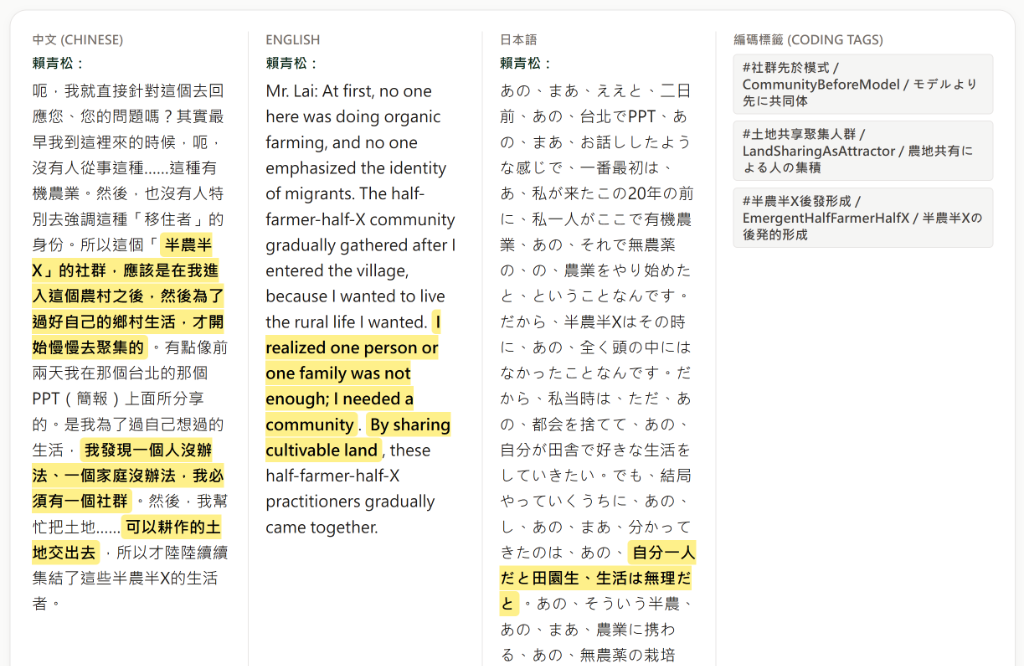
Faced with a massive amount of multilingual (Chinese, English, Japanese) interview audio, we introduced a Human-AI Collaboration process for speech transcription and translation alignment. In the Discover stage, the team focused on mapping authentic viewpoints, introducing coding methods following Nielsen Norman Group (NNG) qualitative research standards.
According to NNG, coding is a systematic "data indexing" process. By assigning descriptive "codes" to dialogue segments, we preserve the behavioral intent, emotion, context, and core concepts of interviewees, making every detail searchable.
This database serves as the factual foundation for subsequent synthesis. The extraction of Themes across different stakeholders is the core task of the next Define stage. In this exploration phase, human-AI coding establishes a clear chain of evidence.
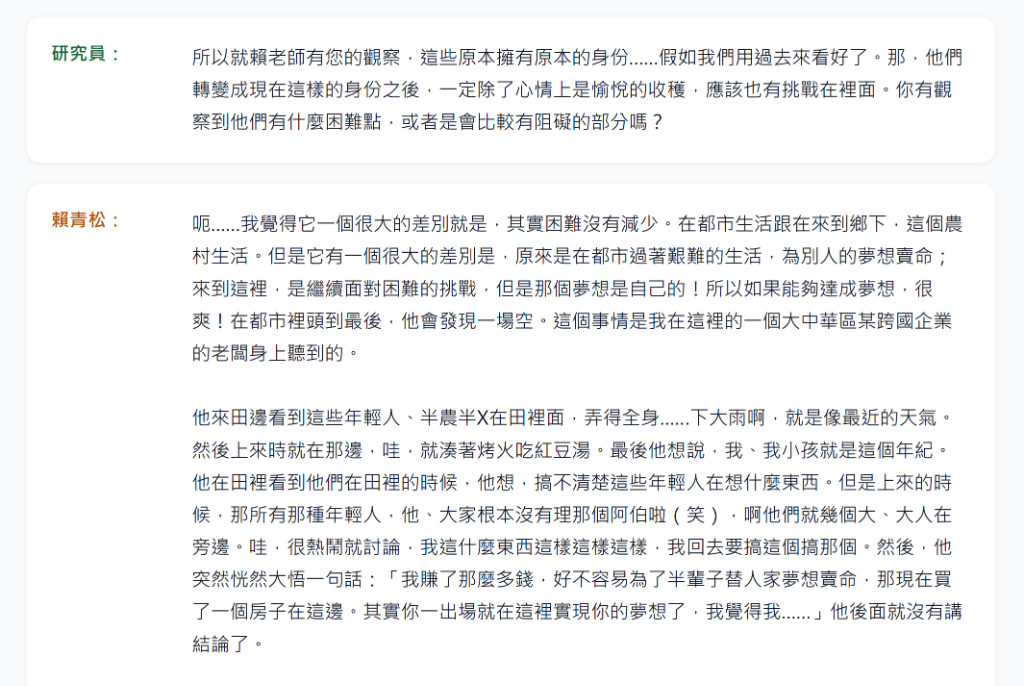
When conducting qualitative analysis, our core workflow consists of first transcribing the audio to generate "transcripts", and then performing "interview coding and tagging" based on these transcripts. In traditional qualitative research, researchers often spend a massive amount of time highlighting and tagging raw materials manually. This time, with the assistance of AI, the transcription and coding consolidation process became fast and highly efficient, allowing participants to focus entirely on understanding the core content and uncovering insights rather than getting bogged down by tedious data summarization. Below are the actual transcript and AI coding notes:
Exploration phase coding is complete. Next, we will extract shared themes in the Define (Framing) phase, moving from divergence to convergence to pinpoint key challenges.